
Maryland's boating community saw several serious accidents in 2016 where boat propellers caused injury and death to passengers. It has spurred two ambitious State legislators to cobble together additional regulations to curb the practice of "bow-riding."
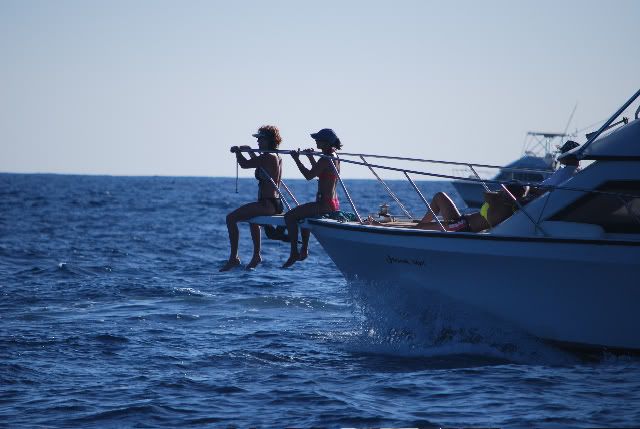
On July 30, 2016 a passenger doves off the bow of a ski boat and was cut by the boat's propeller. The accident was reported as follows:
...Eckenrode was with a party of seven people aboard a 24-foot Moomba power boat when he jumped from the bow of the boat into the water in the area of McHenry Cove without the knowledge of the other boat occupants. Informal instructions were reportedly being given to a new skier in the group at that time.
The boat, operated by Brian P. Morel, 36, of Sewickley, Pennsylvania, was placed in gear to navigate out of the area when the victim was struck by the boat's propeller. http://www.times-news.com/news/local_news/pennsylvania-man-seriously-injured-on-deep-creek-lake/article_c75dad60-6eb0-5c55-85cd-4ff4e9f0554b.html (last checked 12/8/2016).Also on July 30, 2016, at the other side of the state, another propeller injury:
When officers arrived at the scene in Isle of Wight Bay at about 4 p.m., seven people were in the water around a rental pontoon boat that had run aground. One man was bleeding profusely from a gash on his arm created by the boat's propeller and another passenger was hanging onto a nearby moving boat.....the operator of the boat, was arrested after he failed field sobriety tests. http://www.wrdetv.com/index.cfm?ref=60200&ref2=4898 (last checked 12/8/2016)

On August 17, 2016, a boy lost his life, as reported:
Frederick was sitting on the edge of a pontoon boat in Sinepuxent Bay near Ocean City, with his legs dangling over the side when he was hit by a propeller, according to the Natural Resources Police in Maryland.
Natural Resources Police Spokeswoman Candy Thomson said after Frederick fell, the operator couldn’t stop and the propeller hit the boy. She added that it’s illegal in Maryland to dangle in front of a moving boat. http://nj1015.com/howell-boy-dies-in-maryland-boating-accident/ (last checked 12/8/2016)A website that compiles statistics for pontoon propeller injuries across the country notes 198 serious injuries between 1964-2016. Maryland's cluster of accidents (not all pontoons) make up a minor percentage of reported incidents across the country over 52 years. Lawsuits arising from propeller related injury are similarly spread consistently across the years. Anecdotally, then, we can agree that propeller related injuries are a regular occurrence. And of that group, a much smaller subset arise from the practice of "bow-riding" where a passenger is allowed to ride the bow with limbs dangling, or to otherwise ride the gunwales while underway.

Two Maryland legislators have felt compelled to address the situation, announcing soon-to-be-published regulations to ban the practice of "bow-riding" while a boat is underway:
The human reaction to tragedy is understandable--do something-- but there is already an adequate remedy in place. Actually, there are two statutes in place to address dangerous boating operation. One is federal, enforced by the USCG:Last week, [Sen. James] Mathias and [Del. Mary Beth] Carozza, along with DNR and NRP officials, met with the state’s Boat Act Advisory Committee to discuss changes to the regulations that would prohibit bow-riding. Out of that meeting came a proposed regulation change that could put a new law on the books in advance of recreational boating season next spring.Mathias said this week the meeting with the Boat Act Advisory Committee was productive and a new regulation prohibiting bow-riding could be posted in the Maryland Registry as soon as mid-January. Following the requisite public comment period, the new regulation could become effective as soon as March 27 [, 2017]. https://www.mdcoastdispatch.com/2016/12/08/proposed-reg-would-ban-bow-riding-in-state-waters-change-likely-to-take-effect-before-summer/ (last checked 12/8/2016).
46 U.S. Code Sec. 2302
(a)A person operating a vessel in a negligent manner or interfering with the safe operation of a vessel, so as to endanger the life, limb, or property of a person is liable to the United States Government for a civil penalty of not more than $5,000 in the case of a recreational vessel, or $25,000 in the case of any other vessel.
(b)A person operating a vessel in a grossly negligent manner that endangers the life, limb, or property of a person commits a class A misdemeanor.

Maryland has its own prohibition against negligent and reckless boating:
Natural Resources Sec. 8-738.2:
The Maryland Department of Natural Resources even publishes a pamphlet reciting examples of negligent or reckless boating practices to be avoided. Not surprisingly, "bow-riding" is one express example of negligent or reckless boating in the pamphlet. It is not a stretch to say boat operators understand bow-riding to be a negligent and reckless practice.In General
(a) A person may not:(1) Operate a vessel recklessly or in a manner that may endanger another or the property of another on a bay, creek, lake, river, or stream in the State; or(2) Come into a wharf or bathing shore recklessly or in a manner that may endanger a person or property.
Fines and penalties
(b) A person who violates this section is guilty of a misdemeanor and on conviction is subject to: (1) For a first conviction, imprisonment not exceeding 30 days or a fine of not less than $25 and not exceeding $200 or both; and(2) For a second or subsequent conviction, imprisonment not exceeding 60 days or a fine not exceeding $500 or both.
Maryland does not need another regulation or statute to remind boaters to the keep arms and legs of their passengers in the boat while underway. The USCG and Maryland's DNR are both well equipped to enforce the laws already in place. It is a waste of resources, and causes confusion to selectively define and separately penalize subsets of behavior already covered by existing law.


