Showing posts with label ian t. valkenet. Show all posts

Thursday, June 18, 2020

Maryland's Court of Appeals adopts tech changes to make justice more accessible.

This week, Maryland's highest court, which makes the rules dictating how litigation is conducted in all of our courts, adopted rules making access to justice a bit easier.

Spurred by the inconvenience visited by COVID-19, where mandatory closures prevent many court room activities, the Court approved the following;


  • Video conferencing in the District Courts- A visit to the District Court is often akin to a visit to the MVA. The waits are long, the rooms crowded, and you are often told to return, again, on a later day. Soon, many conferences and hearings will be held by video participation.  What remains to be worked out is whether persons without internet or a computer may still participate in person, or whether this innovation has created another practical impediment to court access for some.
  • Electronic filing for appeals- Three of Maryland's largest jurisdictions are Baltimore City, Prince George's and Montgomery Counties. They are not yet set up for electronic filing. Appeals to the courts in Annapolis are thus not done electronically. That has been changed.  While filings in the Circuit Courts must still be mailed or hand-delivered, appellate filings to the courts in Annapolis will be via the on-line portal.  This is a modest improvement, but a step toward uniform efficiency.
  • Remote video depositions- The current rules of procedure do not contemplate remote participation via video. Taping is routine, but it still requires gathering in one location. The conduct of remote discovery can add efficiencies to litigation, while also adding complexities that drive up costs for litigants. It also creates opportunity for shenanigans, where remote deponents may be secretly coached or manipulated by off-camera persons or devices. 
We will help you manage these innovations, and move your cases to the swiftest conclusion our system will allow. Changes must be made, and they will breed additional modifications in how we conduct your cases. We will adapt and grow with them. As the CEO of Uber reminds us, "ultimately, progress and innovation win."

Sunday, November 17, 2019

Your broken contract may limit your recovery.

Reported court cases capture a moment. We can look back at reported decisions for detailed and accurate portrayal of historical events, and conditions. The recent reported decision in AAC HP Realty v. Bubba Gump Shrimp Co. Restaurants, Inc. gives a glimpse through the windows of Baltimore City's once-cherished Harbor Place, to see the consequences of decades long neglect by its owners and operators.

The case arose from complaints that Harbor Place tenant Bubba Gump Shrimp Co. Restaurant brought against its landlord that:

"Shortly after it began its operations at Harborplace in 2012, Bubba Gump observed that the landlord was not maintaining the property in good order and repair. At trial, the restaurant presented ample evidence of poor conditions in the common areas, including water leaks, hanging wires, dirty bathrooms, broken concrete, chipping and peeling paint, escalators that did not work, planters containing trash and debris, rusted metal stairs, and rodent infestation."

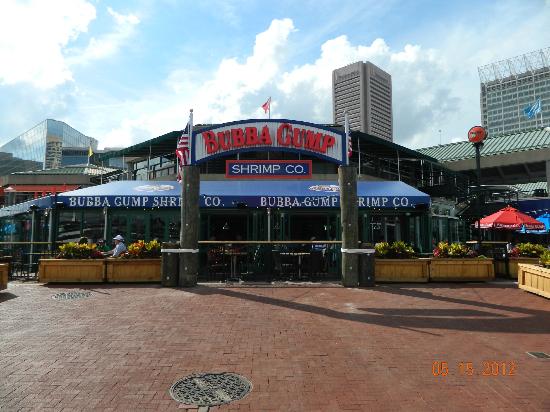
This photo of Bubba Gump Shrimp Co. is courtesy of TripAdvisor

These conditions lead Bubba Gump to sue the landlord for breach of contract, alleging that its lease required the landlord to maintain common areas. Bubba Gump alleged that rat infestation and dirty common areas evidenced a breach of the contractual promises. Bubba Gump estimated that over 20% of its greater than $1 MM yearly rent was attributable to the common area maintenance that was not being performed by the landlord.

As is typical in cases for breach of contract, Bubba Gump's lawyers added additional alternative claims for  unjust enrichment and other claims for equitable relief. It was the appellate court's discussion of this group of equitable claims which gives us a snapshot of Maryland's current law on commercial disputes.

The case reminds lawyers that equitable remedies, like unjust enrichment, are not available where the parties have a contract in place for the same  subject in dispute, and that contract fully covers the dispute. There are exceptions where a fraud has been committed at the inception of the contract (and not its performance), or the existing contract does not fully cover the subject matter of the dispute. This appellate court saves all Maryland lawyers time in the library by reminding that "[n]o reported decision applying Maryland law has ever upheld a judgment based on any of these exceptions."

For this reason, the trial court's decision granting Bubba Gump an equitable discount on rent owed under the leasing contract was reversed. Bubba Gump was entitled to recover contract damages, but the appellate court instructed that the contract also operated to limit the categories and amounts of damages a commercial tenant may collect.

In the end, broken glass, dirty restrooms and rat infestation at Harbor Place netted Bubba Gump recovery of its out-of-pocket expenses and some attorney fees, but no lost profits or return of rent.


Thursday, October 5, 2017

New Maryland foreclosure rules for abandoned or vacant properties.

Lenders may now foreclose faster on abandoned or vacant  Maryland residential properties. 

Senate Bill 1033 went into effect on October 1, 2017. It provides a short-cut to the existing foreclosure rules that prevent a lender from initiating foreclosure until 90 days have elapsed from the triggering event.

There must still be a triggering event, such as an extended failure to pay. But if the property is vacant or abandoned the lender may file a petition in the circuit court for permission to immediately foreclose without notice. The court is required to rule on the petition "promptly."

The petition must include admissible evidence to demonstrate that the property is vacant or abandoned. How is that to be done?  The lender must demonstrate any three of the following eleven factors (the capitalized language is lifted from the new law):

(1) GAS, ELECTRIC, SEWER, OR WATER UTILITY SERVICES TO THE PROPERTY HAVE BEEN DISCONNECTED;
(2) WINDOWS OR ENTRANCES TO THE STRUCTURE ON THE PROPERTY ARE BOARDED UP OR CLOSED OFF, OR MULTIPLE WINDOW PANES ARE BROKEN AND UNREPAIRED;
(3) DOORS TO THE STRUCTURE ON THE PROPERTY ARE SMASHED THROUGH, BROKEN OFF, UNHINGED, OR CONTINUOUSLY UNLOCKED;
(4) JUNK, LITTER, TRASH, DEBRIS, OR HAZARDOUS, NOXIOUS, OR UNHEALTHY SUBSTANCES OR MATERIALS HAVE ACCUMULATED ON THE PROPERTY;
(5) FURNISHINGS, WINDOW TREATMENTS, OR PERSONAL ITEMS ARE ABSENT FROM THE STRUCTURE ON THE PROPERTY;
(6) THE PROPERTY IS THE OBJECT OF VANDALISM, LOITERING, OR CRIMINAL CONDUCT, OR THERE HAS BEEN PHYSICAL DESTRUCTION OR DETERIORATION OF THE PROPERTY;
(7) A MORTGAGOR OR GRANTOR HAS MADE A WRITTEN STATEMENT EXPRESSING THE INTENTION OF ALL MORTGAGORS OR GRANTORS TO ABANDON THE PROPERTY;
(8) THERE IS A DETERMINATION THAT NO OWNER OR TENANT APPEARS TO BE RESIDING ON THE PROPERTY AT THE TIME OF AN INSPECTION OF THE PROPERTY BY:
     (I) THE THE SECURED PARTY; OR
     (II) AN APPROPRIATE OFFICIAL OF THE COUNTY OR MUNICIPAL CORPORATION IN WHICH THE PROPERTY IS LOCATED;
 (9) TWO OR MORE CITATIONS HAVE BEEN ISSUED BY A COUNTY OR MUNICIPAL CORPORATION AGAINST THE PROPERTY FOR FAILURE TO MAINTAIN THE PROPERTY AND A HEALTH AND SAFETY ISSUE EXISTS THAT HAS NOT BEEN RECTIFIED;
(10) THE PROPERTY HAS BEEN CONDEMNED BY A COUNTY OR MUNICIPAL CORPORATION; OR
(11) OTHER REASONABLE INDICIA OF ABANDONMENT EXIST.
As you can see, there is a lot to pick from, and each alleged "fact" is an opportunity for dispute at the court's "prompt" hearing. The borrower has an opportunity under the new rule to deny the alleged facts supporting the petition. What is not clear is whether a borrower can be given the opportunity to cure the conditions on which the petition is based (in addition to bringing the loan current), and thus render the petition moot or premature.

But shortening the process for foreclosure on vacants may not be enough to entice lenders to execute on recorded liens. Lenders may continue the practice of electing a breach of contract action against the borrower in order to obtain a money judgment. It is the business practice of some lenders to seek court judgment against the borrower on the underlying promissory note, while leaving the recorded lien intact as a cloud on title. This practice makes it even less likely that a vacant or abandoned property will be recycled to productive use. The new rule does nothing to remove this choice from the lender--- a bank cannot be forced to foreclose, even if the borrower is delinquent, and especially if the property is abandoned or vacant.

Do you need to file or defend such a petition? Fill out our contact form on this page and let's discuss your case.