“Property is surely a right of mankind as really as liberty.”- John Adams
Our second President of the United States wrote
this in 1787. And for over three hundred years, the ownership of property
has been the foundation of American society.
Originally, only land owners could vote or govern. We live in a culture that largely
measures worth and success if you can afford to own land, develop it, and profit
by it’s sale to others, who begin the same cycle for themselves.
“A man’s home is his castle” rings as true, today, as when it was first
uttered in four hundred years ago, by Lord Coke. Right?
Not so fast.
If “ownership” of land and buildings is defined as that full bundle of
rights to control and dispose of the property (what is called the full “fee”
interest), then you absolutely are not free to do as you please. Even if you
purchased the full fee interest of a property, there are many layers of control
and limitation on your rights to use and dispose of that property. Here are a
few that you may not have considered.
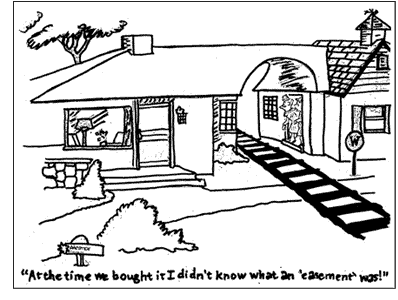
Easements
are the right of use over the lands of another. Your neighbor, the government or even
the utility company have rights to physically intrude on your land. Your neighbor may have a right to drive his
farm tractor across your lot to access adjacent
lands. The government may have rights to keep you from using parts of your land
(we recently had a case involving a “blast zone” easement near a former Nike
missile site owned by Uncle Sam). The utility can run power lines and poles over your land. And perhaps the entire community behind your
lot may have a right to use your road to access the public highway.
Environmental easements will also sneak up on you, if you are not
careful. That new subdivision may have areas set aside for trees only, or "buffers," or just open space designated as a “conservation easement.” Maryland has
one of the most active open space/environmental easement programs in the
Country. Some of our clients have been caught short by easements
created by prior owners who just wanted to capture a tax break.
Governmental
restrictions and private covenants also limit how you use
and enjoy your property. Most commonly, zoning restrictions impose limits on
businesses in residential areas. Your neighbor doesn’t want to live next to a motorcycle
repair shop! And the government doesn’t want that sex toy shop too close to an
elementary school. The largest court disputes
arise where residential and business zoned areas rub against each other. “Not
in my back yard,” is the usual protest by homeowners, while the business man
swears that he is enhancing the community.
If you live in a planned community (whether brand new, or as old as the Homeland
and Roland Park neighborhoods in Baltimore City) then you are subject to
restrictions created by written restrictions on what you can do with your land,
called “covenants.” You might be required to submit any proposed changes to
your house to a community architectural committee for approval. We have seen
disputes ranging from “don’t let your kids play basketball after 9 PM,” to “tear
down that garage because it was not approved by the homeowner’s association.”
Even if you did not read your covenants at settlement, you are tied up in their
restrictions!
Live on or near the water? Well, your land is likely subject to the rights of
others to access the beach or a boat ramp. And be assured that the State of
Maryland has many restrictions on how close you may build to the water, what
you can build. Your neighbors might even have shared use of your waterfront and
pier. And if Mother Nature creates more land by depositing dirt and sand along
your property, you may actually own a larger lot. But if Mother Nature washes that land away,
you own less. But be careful about protecting your land—the State of Maryland
has tough requirements for “rip-rap” and other methods of erosion protection. We
recently advised a client against conflicting claims by the State and their
homeowner’s association about maintenance of rip-rap and beachfront property. And
don’t dare disrupt wetlands or tidal lands, or you will hear nasty things from
the State of Maryland.
You are not immune from government intrusion involving water just because you
live inland, near a casual stream or storm conduit. If that water feeds a river and makes its way
to the Chesapeake Bay or ocean, then you are subject to federal
restrictions. One of our past clients
thought he was doing a good deed by depositing stones and highway rubble into a
stream to slow water flow and save his land from erosion—and he was wrong! A
violation notice from the federal government forced removal of the stones and payment of
a fine.
Liens are the right given to another by the owner of property to secure a debt, or one created by law in favor of certain creditors. If you borrowed money to purchase your house, then you are already familiar
with bank liens evidenced by mortgages, and deeds of trust. These are
consensual liens, or liens that you agreed could attach to and encumber your
property.
But most liens on your property will be non-consensual. For example, unpaid
taxes, water bills, homeowner’s association dues and ground rents will all
become liens on your property. And
general debts that become court judgments will also become liens on your
property once recorded in the Circuit Court for the County in which the
property is located.
And if you own property with others (particularly others to whom you are not
married), you must be concerned for non-consensual liens attaching to their
interest. Any impairment of their
interests will necessarily effect your interest.
Consensual and non-consensual liens all share one thing—they can be foreclosed
by the lien holder. Our office is frequently involved in disputes among
competing lien holders, all jockeying for the first priority position, like
beasts feeding on fallen prey. These disputes are never good news for the property
owner, who is simply waiting for the court to select his financial executioner.

The resolution of property
disputes involving easements, restrictions and liens keep lawyers plenty busy.
There are many ways that these matters end up in court:
Foreclosures occur once an owner is in default of obligations under a consensual or non-consensual lien. The filing of a foreclosure case can trigger multiple disputes among lien holders
claiming first lien position. These disputes often have the unintended benefit
to the borrower of postponing the foreclosure sale and ratification which would
require him to move out of the home. In
fact, we have seen several cases where a borrower in default lived another four
years in the home without making a single mortgage payment.
And if the foreclosure generates a pile of money left over after the
foreclosing lender gets paid, then lesser lien holders will file competing
claims to the surplus. If there is anything left, it goes to the owner. And
each step can involve a contested court hearing.
Quiet Title and declaratory judgment actions—Short of foreclosure, competing
lien holders may sue each other while asking the courts to pick the first lien
holder. The grounds for these claims are
seemingly limitless, and often do not involve the property owner. But this will
not lessen the property owner’s stress level, since he is often made a party to
these cases. We are often consulted to explain to the property owner what is
happening in these cases.
Bankruptcy-Disputes over consensual and non-consensual
liens arise in the main case, whether a Chapter 7 or 13, and can often spill
over to a separate adversary proceeding. For example, a bankruptcy trustee
might attack the validity of a lien, perhaps because it was not properly
recorded or executed at the time it was made.
When the economy tanked in 2008, our office received a flood of these
claims. At one point, we had approximately 65 cases involving this particular
issue. Four representative cases were
selected by the bankruptcy court for referral to the Maryland Court of Appeals,
where we argued discrete points of Maryland law. Once decided, the point of law
resolved all of the bankruptcy cases in favor of our client.
Extended fighting among trustees, debtors and competing lien holders in the
bankruptcy court also has the unintended benefit to the borrower of stalling an
eventual foreclosure. But many lenders and bankruptcy trustees agree to have
property sold, while agreeing to fight over who gets paid out of the fund. That means the borrower loses the house even
as the lien holders continue to fight.
Property ownership is not easy. In fact, ownership is less about enjoying the
property, and more about excluding others and defending against encroachments
on your interests. This requires constant diligence. It may even require court
action.